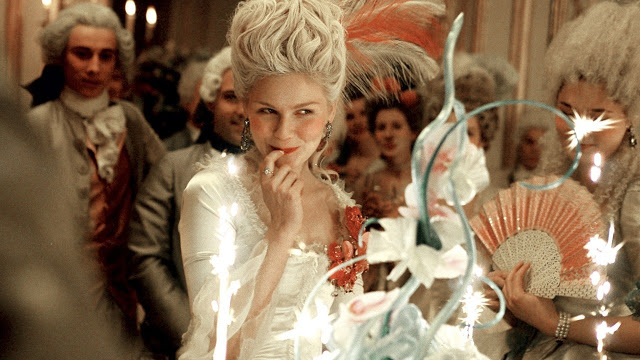
 |
| Kirsten Dunst in Sofia Coppola’s Marie Antoinette |
Many chastised Sofia Coppola’s re-imagining of Marie Antoinette. Some critics complained about the addition of modern music while others thought it looked too slick, like an MTV music video (remember those??). But I think most people missed the point. Beyond the confectionary colors, gorgeous shots of lavish costumes and a teen queen munching on decadent treats and sipping champagne is a compelling and heartbreaking film that transcends eye candy. Underneath the exquisite atmosphere exists a very powerful and feminist commentary on gender and women.
Marie Antoinette chronicles the life of Austrian-born Maria Antonia Josephina Joanna (Kirsten Dunst) as she becomes the Dauphine and then Queen of France leading up to the French Revolution. Writer and director Sofia Coppola loosely based the film on Antonia Fraser’s sympathetic biography of the French queen. Coppola injected the dialogue with actual quotes from the queen’s life. Dunst skillfully exhibits the queen’s naïveté, loneliness and charisma. In an outstanding and underrated performance, she adeptly captures the jubilance of a young woman who desperately desires freedom as well as a woman burdened with the knowledge that her only value lies in her ability to bear children.
In the beginning of the film, we see Marie Antoinette travel from her homeland of Austria to France as her mother has arranged for her to be married to the Dauphin, Louis XVI (Jason Schwartzman) in order to unite the two antagonistic kingdoms of Austria and France. In a heartbreaking scene, Judy Dench tells Marie Antoinette she must leave everything she knows behind to make room for her new French identity, including abandoning her adorbs dog Mops. No, not her dog! That scene seriously broke my heart reducing me to tears. Marie Antoinette is upset yet she swallows her pain and obeys. She enters a tent placed on the two countries’ borders, entering on Austrian soil and exiting on French land. In the tent, she must strip off all of her clothes in order to don her new French garb – a symbol of her having to strip away her identity.
Once Marie Antoinette marries Louis XVI, we see Versailles’ ridiculous and over the top traditions again and again. Every morning, an entourage of servants and royalty awakens Marie Antoinette, dressing her in garments with outlandish pomp and ceremony.
As she navigates royal society’s mores, we witness Marie Antoinette’s close friendships with the free spirited Duchesse de Polignac (Rose Byrne) and the reserved Princesse de Lamballe (Mary Nighy). When she is told she should choose more appropriate friends, particularly ditching Duchesse de Polignac, Marie Antoinette defends her friend saying she enjoys her fun spirit. Yes, there are moments when Marie Antoinette indulges in vapid, decadent luxuries. But people forget she’s a teenager. Um, that’s what they do! To take her mind off the constant societal pressure, she distracts herself by gambling, singing in plays and shopping. She’s so confined by societal expectations; she’s exploring her identity and experimenting as much as she can.
Marie Antoinette’s mother, the Austrian duchess Maria Theresa warns her, “All eyes will be on you.” After their wedding night, it’s clear that Louis XVI has no sexual interest in his bride. Through her constant letters, Maria Theresa perpetually reminds her daughter that “nothing is certain” about her place until she gives birth to a son. Even after Louis XVI is crowned king and Marie Antoinette becomes queen, her place is still not entirely secure until she has a son. After her sister-in-law gives birth to a son, Marie-Antoinette feels even more pressure to have a child. Her mother condemns her for not being charming enough or patient enough to entice her husband. As Marie Antoinette reads her mother’s letter, the stinging words wound her, we see and feel her solitary pain.
Women were reduced to their vaginas, only valued if they got pregnant so they could produce an heir. No one bothers Louis XVI about this, even though he’s the one who doesn’t want to have sex. Nope, just the woman; of course she’s to blame. Eventually after 7 years with no children, Marie Antoinette’s brother, the Holy Roman Emperor, talks to him. But Marie Antoinette is repeatedly blamed for not becoming pregnant. Clearly her body and reproduction are her only salient attributes in the eyes of society.
Throughout the film, we’re reminded that women aren’t desirable, lesser than men. When her first child a daughter is born, Marie Antoinette says to her:
“Oh, you were not what was desired, but that makes you no less dear to me. A boy would have been the Son of France, but you, Marie Thérèse, shall be mine.”
In a world where nothing, not even her own body truly belongs to her, it’s touching to see Marie Antoinette, a devoted mother, take such joy in her relationship with her daughter.
Throughout history, people erroneously vilified Marie Antoinette, attributing her with more political influence than she actually possessed. And of course she was demonized after she supposedly told starving peasants, “Let them eat cake.” As civil unrest grows inching ever closer to revolution, the film’s Marie Antoinette says she would never say such a thing. Because of her Austrian heritage and I would also argue her gender, Marie Antoinette was repeatedly used as a scapegoat for France’s financial woes and the public’s strife.
The film divided audiences. At the Cannes Film Festival, critics notoriously booed yet it also received a standing ovation. Some critics dismissed it, saying it was nothing more than a pop video or that “all we learn about Marie Antoinette is her love for Laduree macaroons and Manolo Blahnik shoes.” Sofia Coppola, who consciously chose to omit politics from the film, fully acknowledged Marie Antoinette was not a typical historical biopic:
“It is not a lesson of history, it’s an interpretation carried by my desire for covering the subject differently.
Would people still complain and moan if a dude was at the center of the film or a dude had directed this?? Nope, I think not. Does anyone else remember that Mozart acts like an immature douchebag in the critically acclaimed Amadeus??
But some delved deeper, understanding its rare beauty. Critic Roger Ebert praised Marie Antoinette astutely pointing out:
“This is Sofia Coppola’s third film centering on the loneliness of being female and surrounded by a world that knows how to use you but not how to value and understand you.”
Told almost entirely from the Queen’s perspective, we see the world through Marie Antoinette’s eyes. Her loneliness and the pressure she faces to be everything to everyone is palpable.
With its commentaries on gender, women’s agency, reproduction and female friendships, Marie Antoinette is surprisingly deeper and more feminist than many realize. Sofia Coppola created a lush and sumptuous indulgence for the eyes. More importantly, by humanizing the doomed queen and adding modern touches, Coppola reminds us of the gender constraints women throughout history and today continually endure.
I liked this one a lot more than i thought i would
“This is Sofia Coppola’s third film centering on the loneliness of being female and surrounded by a world that knows how to use you but not how to value and understand you.”
True, sadly