 |
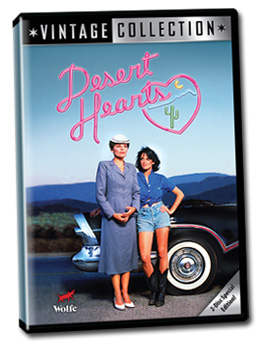
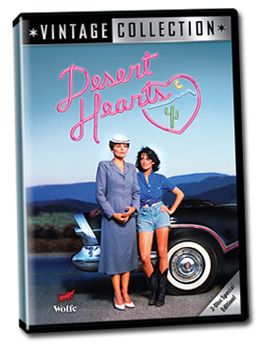
| DVD cover image of Desert Hearts |
Desert Hearts is one such film for me. In the fall of 1986, still a kid of 22 who had just moved to the city from Podunk, Indiana, I went to the theater in a Boston suburb. There I remember looking around at the audience. I had a hard time believing that I was watching a lesbian romance film in a public place. I don’t think I breathed during the love scene. For the first time in my life, in a mainstream movie theater, I watched a film that gave me a model for what love could be. It made me want to fall in love, to find my own Cay or Vivian and hop on the train to start a life together.
It is a conventional romance, which is one of the reasons that it is so successful. As Jackie Stacey points out, “it uses the iconography of romance films: train stations, sunsets and sunrises, close-up shots, rain-drenched kisses, lakeside confessions, ‘I’ve never felt this way before’ orgasms.” It is those Hollywood conventions that conjure up shared memories of hundreds of heterosexual romances. Thus the filmmaker uses what are sometimes clichés as shortcuts to elicit particular emotions and reactions from the audience. Although the world of 1959 would certainly have been more challenging for these two lovers in the real world, the cinematic world Deitch created signals that there is an all-important happy ending coming up, a romantic Hollywood ending.
Deitch’s use of music also contributes to the romance convention. The country songs of Patsy Cline, Jim Reeves and Johnny Cash are very emotionally evocative. In particular, they conjure up a feeling of wanting that comes from knowing the themes and voices that accompany these artists’ work. The soundtrack, which took up a large portion of the film’s budget, makes brilliant use of the audience’s previous knowledge. We know how we should feel before the scene plays itself out.
 |
| Cay and Vivian in Desert Hearts |
Placing the film’s setting in Reno also taps into our shared impressions of the West from movies and popular culture. It is a place in which one can start a new life and throw caution to the wind. The chances for romance certainly would not have felt so hopeful without the wide open spaces and bright, beautiful colors of the Nevada desert. Cay’s cowboy boots and western clothes make her the equivalent of the cowboy who sweeps the newcomer to town off of her feet. It’s the wild westerner who charms the shy school marm, just like we’ve seen a million times in the movies.
Others (like Mandy Merck) discuss Desert Hearts as conventional, criticizing it for not being challenging enough, not tackling issues of lesbian identity, for example. For me, that criticism totally misses the point. Deitch intentionally did not make an issues kind of film. She took Hollywood formula and tilted it on its ear, creating a lesbian love story that audiences still crave today.
———-
Angie Beauchamp is a freelance internet marketer, making her living by managing other people’s blogs and social media. She also runs the Lesbian Film Review.
11 thoughts on “LGBTQI Week: Revisiting ‘Desert Hearts’”
Comments are closed.